
You're tired.
There's no reason for it. You're awake, you're functioning, but something never quite switched on this morning and it's already 3pm.
So you blame the week. Then the month. Then your age, which is a stretch, because you are nowhere near old enough to be blaming your age.
You start going to bed earlier. Nothing changes.
You buy the better coffee. 90 excellent minutes, and then you're flat again.
Your legs ache on the stairs.
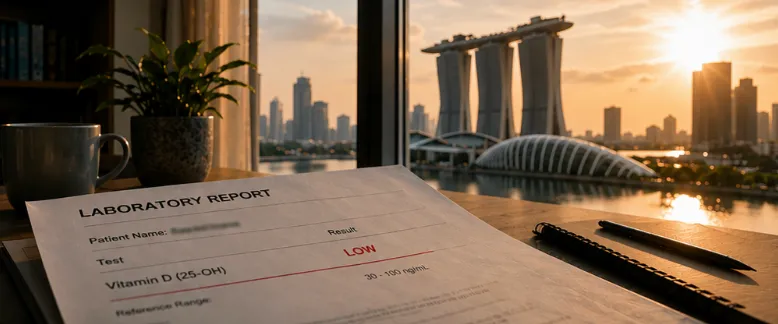
Then one day you get a blood test for something else entirely, and near the bottom of the page there's a single line flagged in red.
Vitamin D: LOW.
In Singapore. Where the sun comes out almost every single day.
How does that even happen?
You're not the only one asking. About 4 in 10 people in Singapore are low on vitamin D.
To understand how that happens, it helps to understand something strange about vitamin D first.
It Isn't Even A Vitamin
"Vitamin D deficiency is the most common medical condition in the world." Dr Michael Holick, The Vitamin D Solution
Despite the name, vitamin D doesn't behave like most vitamins.
A vitamin is something you have to eat, because your body can't make it.
Vitamin D breaks that rule. Your skin makes it, from sunlight, for free.
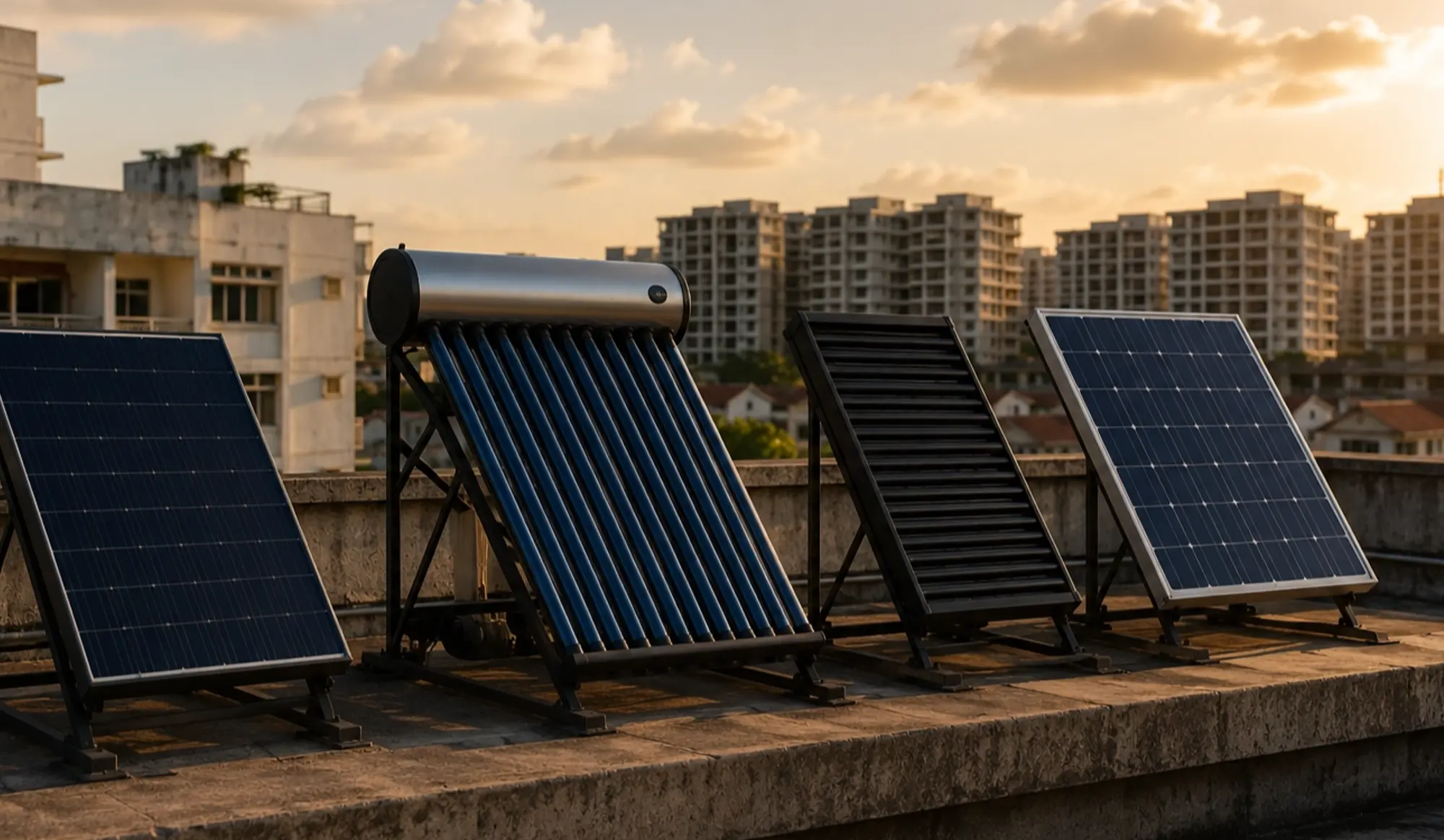
Which makes your skin a solar panel.
What does it help power? Your bones are a big part of the story.
Vitamin D helps your body absorb calcium. Not enough vitamin D means not enough calcium, and that can show up as aching bones and weak, tired muscles.

But not everyone falls short in the same way.
Because every panel is a little different.
Same Sun, Different You
"Melanin ... served as a superb natural sunscreen." Nina Jablonski, Skin Color Is an Illusion, TED
Put two colleagues on the same bench at East Coast Park. Same sun. Same ten minutes.
They may not make the same amount of vitamin D.
Why?
One reason is melanin.
Melanin is the pigment responsible for much of the variation in human skin colour. The more melanin you have, the darker your skin.
It also provides natural protection against ultraviolet radiation. That's part of why fairer skin tends to sunburn more easily. Less melanin means less natural protection from UV radiation.
But that protection comes with a trade-off.
Melanin blocks UVB too.
UVB is the part of sunlight your skin uses to make vitamin D. So the more melanin you have, the more UVB exposure your skin may need to make the same amount.
The sunlight may be the same. What reaches the panel isn't.
And Singapore's own numbers show how big that difference can be.
In one local study of 197 healthy women, vitamin D insufficiency was found in 89 per cent of Malay women and 82 per cent of Indian women, compared with 56 per cent of Chinese women.
Skin colour alone doesn't explain those numbers. Diet, clothing, lifestyle and how much time we actually spend outdoors can all play a part too.

But making vitamin D is only half the job.
Your panel still needs a way to actually use what it makes.
And part of that is written into your genes.
Vitamin D Has A Receptor
Making the power is one thing. Using it is another.
One of the genes involved is called VDR.
The VDR gene contains the instructions for making the vitamin D receptor. This receptor allows your cells to respond to vitamin D.
Think of it as part of the wiring behind your solar panel.
Like many genes, VDR comes in slightly different variants.
Research has linked some of these variants to differences in how people process and respond to vitamin D.
And VDR isn't working alone. Other genes are involved in carrying and processing vitamin D too.
So even with similar sunlight, diet and routines, two people may not handle vitamin D in exactly the same way.
Same basic system. Slightly different wiring.
Your genes explain part of it.
Not all of it.
Living Your Life By Design
So how do you actually get more vitamin D?
1. Take Your Sunlight On Purpose
Living in a sunny country doesn't automatically mean you're getting enough UVB exposure.
Think about how much of your weekday actually happens outdoors.
Home. Covered walkway. MRT. Office. MRT. Home.
Some time outdoors can help. How much you need varies with your skin, the time of day and your individual circumstances.
And that sunny window seat?
Ordinary glass blocks most UVB.
The warmth gets through.
Much of the vitamin-D-making UVB doesn't.
2. Eat Like You Work Indoors
Oily fish such as salmon, sardines and mackerel are among the better natural food sources of vitamin D.
Egg yolks and fortified foods can contribute too.
Food is another piece of the puzzle.
3. Find Out How You're Wired
If you've been doing everything right and your numbers still won't budge, the question may not only be how much vitamin D you're getting.
Your biology may add another layer to the story.
Genetic insights can show you variants in genes involved in vitamin D pathways and give you more context about how your body may differ from someone else's.
Where your DNA report covers these genes, a Bio-Profile can help you understand that wiring.
4. Don't Self-Prescribe A Mega-Dose
Vitamin D is fat-soluble, so excess amounts can accumulate in the body.
More is not automatically better.
If you're concerned about your vitamin D level, get measured and speak to a qualified healthcare professional about what is appropriate for you.
Conclusion
"It is not only light but direct sun-light they want." Florence Nightingale, Notes on Nursing, 1859
We live almost on the equator, with sun nearly every day.
And somehow, many of us spend most of our lives avoiding it.
We built the shade, the air-con, the covered walkways and the underground shortcuts, and every single one of them was a good idea.
Our biology simply didn't get the memo.
But by now, you know that sunlight is only the beginning.
The sun provides the input.
Your skin is the panel.
Your biology is part of the wiring.
How much sunlight reaches your skin matters.
So does what your body does with the vitamin D it makes.
That's where knowing your own biology gets useful.
It gives you context for the parts you can change.
Genes are an explanation, not a sentence.
Quick Answers
Low Vitamin D Despite Sunshine?
Yes, it happens. Sunshine outside does not always mean enough UVB reaches your skin. Time spent indoors, clothing, skin pigmentation and other factors can all affect how much vitamin D you make.
Do Genes Affect Vitamin D?
Yes. Genes involved in carrying, processing and responding to vitamin D can contribute to differences in vitamin D levels between people.
What Is The VDR Gene?
VDR carries the instructions for making the vitamin D receptor, which allows your cells to respond to vitamin D.
Why Am I Always Tired?
Low vitamin D is one possible reason. It plays a role in calcium absorption and muscle function, so a real shortfall can show up as ongoing tiredness and weak, aching muscles, even when your sleep itself is fine.
Sources
- Prevalence of Vitamin D Deficiency in Singapore: Its Implications to Cardiovascular Risk Factors (PLOS ONE, 2016)
- Prevalence and Awareness of Vitamin D Deficiency (Ministry of Health Singapore, 2018)
- The Vitamin D Solution, by Michael F. Holick (2010)
- Skeletal and Extraskeletal Actions of Vitamin D: Current Evidence and Outstanding Questions (Endocrine Reviews, 2019)
- Skin Color Is an Illusion (Nina Jablonski, TED, 2009)
- Vitamin D and Its Relationship with Markers of Bone Metabolism in Healthy Asian Women (Journal of Clinical Laboratory Analysis, 2013)
- The Association of VDR, CYP2R1, and GC Gene Polymorphisms, Dietary Intake, and BMI in Regulating Vitamin D Status (Diseases, 2025)
- Sunlight and Vitamin D: A Global Perspective for Health (Dermato-Endocrinology, 2013)
- Notes on Nursing: What It Is, and What It Is Not (Florence Nightingale, 1859)
Where your DNA report covers them, the Bio-Profile reads your vitamin D and skin traits side by side. Why genes explain only part of the story is in Your Genes Have An Impact, It's A Multiplier!.