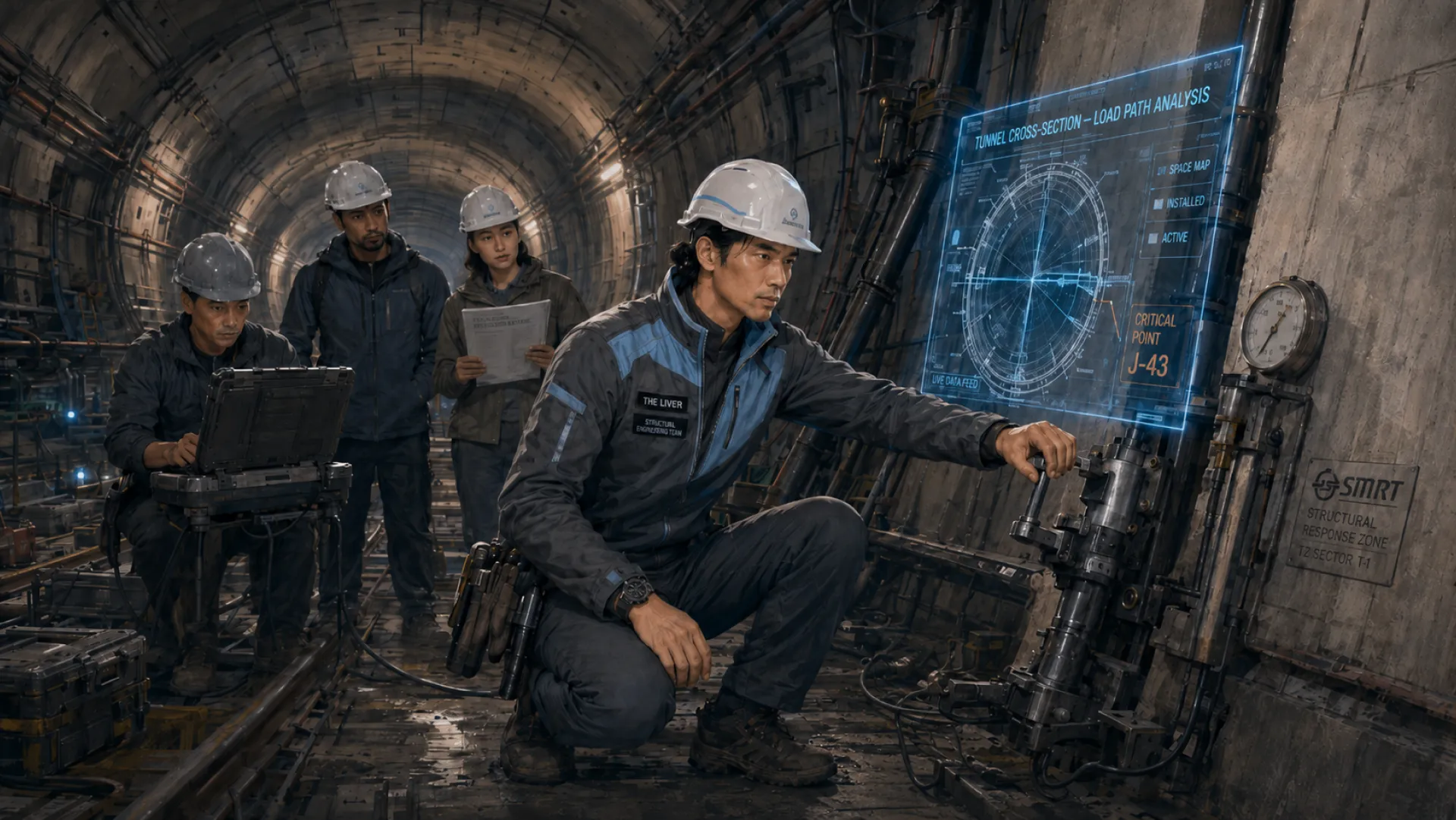
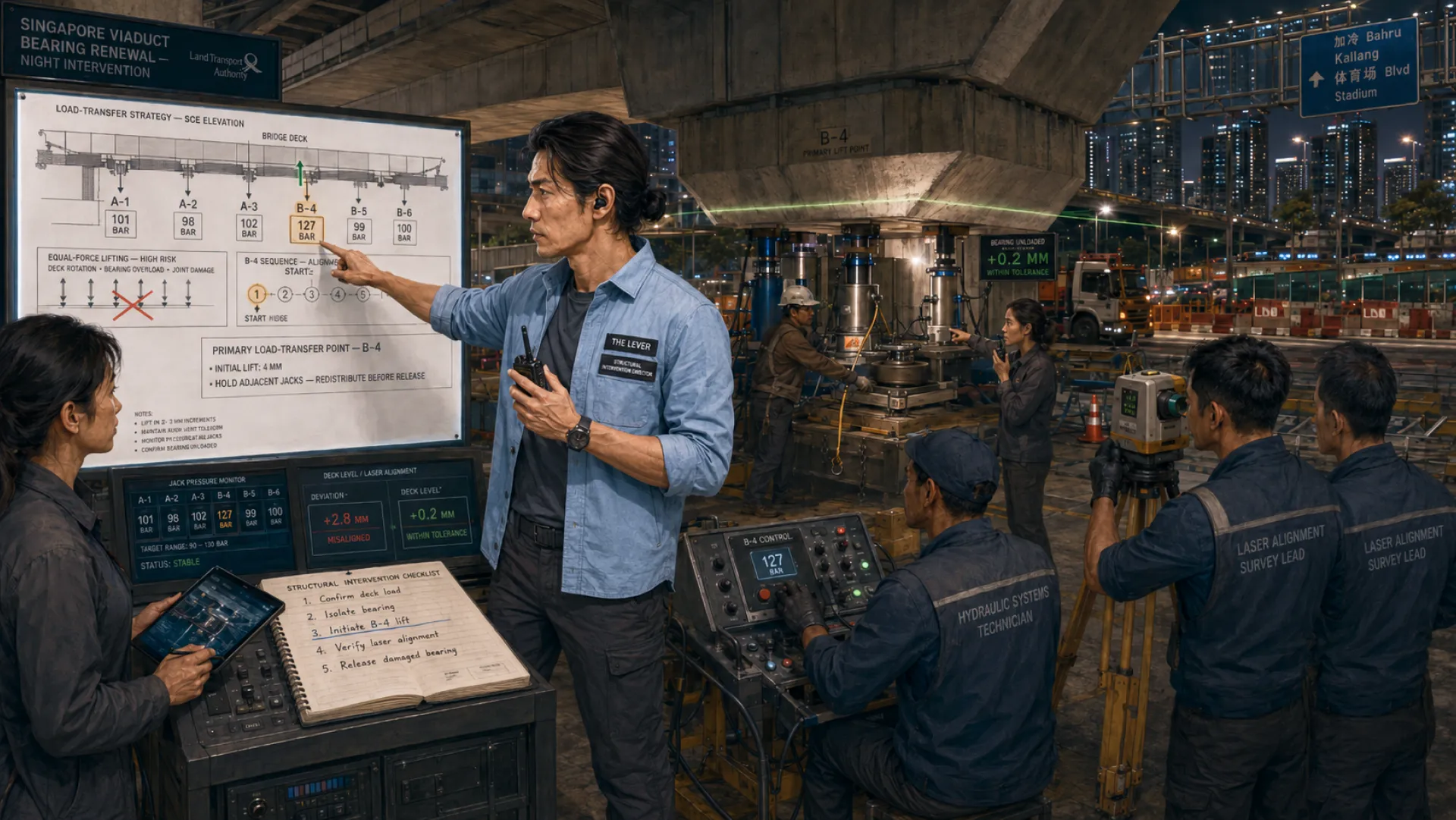
Here is a situation you might recognise. Something is stuck. Everyone around it is pushing, from several sides at once, with a lot of effort and very little movement. You are not pushing. You are walking round it, looking for the one place where the whole thing is actually held together, because that is the only place worth touching.
When you find it, you press once, and the thing moves. People who watched you do almost nothing for an hour tend to be surprised by what happens in the next minute. They were watching your effort. The result came out of your placement.
None of that is patience, and none of it is personality. It comes from five biological settings that all arrive at the same answer.
Your DNA is not just about eye colour or height. Deep inside your genes are instructions that shape how your muscles are built, how your body produces energy, how your skin guards itself, how your brain pays attention, and how your mind integrates information. Together, these five biological settings create what we call your DNA-Archetype.
Yours is called The Lever.
The short version
You do not need to be the strongest thing in the room. You need to know where to press. Your body reads a situation and keeps moving until the angle is right. Your energy waits, builds, then goes all at once. Your skin takes the pressure, the grip and the heat without reacting. Your attention goes to one structure at a time, and your mind maps that structure until the point of maximum leverage is visible. Then you press.
You can only represent very big ideas in very small spaces. G. K. Chesterton, Tremendous Trifles, 1909
Why DNA?
Think of DNA as a recipe book written for you before you were even born. Each recipe describes how to build a different part of you: a type of muscle fibre, a kind of brain cell connection, a layer of skin. You may not have chosen these recipes, but that does not lessen their influence on you.
Therefore, some things about how you work cannot be attributed simply to your habits or personality. You can think of them as your body's factory settings. Knowing your factory settings lets you stop working against your own grain, and start designing a life that fits yourself.
These are your factory settings. You did not choose them, but once you know them you can design around them.
The five settings that make you The Lever are: Adaptive Body, Power Energy, Protected Skin, Focused Social Wiring, and Analytical Mind. Let us take a look at each setting.
02 Your Genetic Build
Your five settings
Five settings make you The Lever. Each one is a choice your genes already made, and each one shows up in how you live.
Physical A
Adaptive
Your connective tissue and the genes that regulate it are tuned to reorganise rather than to hold one shape. A body built for durability keeps its structure while the load presses on it. Yours keeps changing its structure until the load is somewhere easier to move. It reads the ground, the angle and the resistance, and it puts you where less force is needed.
In daily life this shows up as capability across a wide range of physical demands rather than a top mark in one of them. You pick up unfamiliar movements quickly. You find your footing on new ground faster than most people do, and you rarely need telling twice how a thing wants to be held.
Paired with Power energy, your Adaptive body produces the thing this DNA-Archetype is named for. The adjusting has a purpose and an end point. It stops the moment the angle is right, because that is the moment the force gets released, and it will not settle for a workable position when a better one is one step away.
Energy P
Power
Your metabolic genes are set to release energy fast and in quantity. Fast-twitch fibre, quick-loading fuel, a system that empties and refills rather than one that pours at a constant rate. You are built for short, concentrated effort at high quality, and the concentration is the point.
One hour of your best work will often beat three hours of even work, and the gap between them is not small. Your output peaks when the demand is concentrated and when there has been real recovery since the last peak. Spread the same total effort thinly across a day and you will get less out of it, not more.
Power energy and Protected skin together give you a store. The energy builds while you hold a position, and a barrier this durable takes the pressure, the grip and the heat of that hold without any surface response at all. That is why the release, when it comes, arrives without a run-up that anyone else was able to see.
Skin P
Protected
Your genes build a thicker, more durable skin barrier. It takes a stronger input to produce any visible surface response, and your sensory threshold for touch, pressure and temperature is set high to match. Physical conditions register with you late, and the load they leave behind shows on your skin later still.
Day to day that shows up as tolerance. Heat, noise, mess, friction, long hours in poor conditions: your skin logs all of it at a higher threshold than most, so you can keep working in places that leave other people's skin raw. The cost sits on the other end of the same wire. By the time anything is visible on your surface, the load behind it has been accumulating for days.
For your combination, this is the holding mechanism. Finding the exact angle means holding awkward positions, gripping hard surfaces and staying in one place longer than is comfortable. Your barrier absorbs all of that without complaining, so the search for the right position is never cut short by your own skin.
Social F
Focused
The genes shaping your brain's social reward system are calibrated for depth. Your dopamine signal strengthens when you invest heavily in a small number of commitments, and it stays quiet when you spread yourself across many. Breadth does not pay you. Depth does.
In practice you have a small number of people and problems that get all of you, and a very large category that gets none. Your attention has no low setting. It is on, or it is off, and the crossing between the two is quick enough that other people notice it happen.
For your combination, Focused wiring is what makes the analysis deep enough to be worth anything. You are not surveying a wide field for several usable points. You go down into one structure until you have it mapped well enough to know exactly where it will give, and a shallow read of ten systems would never tell you that about any of them.
Mind A
Analytical
Your brain's prefrontal networks favour sequential, structured processing. You build understanding one layer at a time and test each layer before adding the next. You want to know how a thing works before spending anything on changing it, and the reason is practical: you are about to stake the whole press on one point in that model, so the model has to be right.
The distinction that matters most for your combination is between calculating a leverage point and sensing one. Yours is calculated. You can say which member carries the load, which connection is doing more than it was built for, and what moves if that connection moves. The reasoning goes on a page. Someone else can check it, disagree with a step, and turn out to be right, and that is a feature.
That has a consequence people underrate. A calculated point can be defended, taught and reused. When your placement is questioned you never have to fall back on how sure you feel, because the working is there to be walked through. In rooms where being right is not enough on its own, that is the difference between an answer and a decision.
03 Natural Strengths
What you do well
All five of your settings point at the same job. You read a structure until you can see where it is held, and then you spend very little moving it.
Reading where the load sits
Your Analytical mind and your Adaptive body work the same question from two ends. Your mind builds the map: which parts carry weight, which joints are doing more than they should, what depends on what. Your body works from the other side, testing positions and finding where the resistance actually is rather than where the drawing says it should be. Between them you end up with a picture of how a structure is really standing up.
This makes you unusually good at the question of why something is failing. Most of what presents as a broad problem is one connection giving way and everything downstream reporting it. You can find that connection, name it, and show the chain that leads back to it. The improvement that follows tends to look out of proportion to the change that produced it.
Most large problems are one small thing failing loudly in ten places.
Held force, exact release
Power energy loads and Protected skin holds. The effort happens over hours nobody is watching, and what arrives in public is the result on its own. Your barrier is the part that lets those hours be spent in awkward positions and poor conditions without your skin making you stop.
What this produces is specific rather than general. You deliver one exact thing instead of a broad impression of progress. It has real force behind it, because Power energy does not do gentle, and it arrives clean, because nothing leaked out of you while it was being built.
Concentrate your energy and hoard your strength. Sun Tzu, The Art of War, chapter 11 (trans. Lionel Giles)
Position before commitment
Your Adaptive body and Focused social wiring produce the same habit in two different domains: you will not take a position until the angle is right. Physically, that is your body adjusting until the load sits somewhere you can move it. Elsewhere, it is your attention refusing to land until the structure has proved worth landing on.
You will see it in a negotiation, where you keep changing your approach as the real shape of the conversation appears, and in a project, where you read the ground for longer than anyone expected before placing the first thing. From outside, that period can look like slowness. It is the part of the work that makes the fast part possible.
Nobody counts the hour you spent finding the angle. It shows up in the minute that follows.
A small input, a structural result
All five settings converge on one capability: a small, well-placed input producing a change far larger than itself. The question you ask about a hard problem is a different question from the one most people are asking. They want to know how much force to apply. You want to know where.
It shows up most clearly where complexity is high and broad pressure has already failed. A situation that has absorbed months of general effort without moving is exactly what your combination is built for, because a structure that resists everything usually has one place where it does not.
04 Friction Points
Where it costs you
Nothing here is a fault. Each one is the same wiring that makes you accurate, running somewhere it was never built to run.
The load that never surfaced
Your Protected barrier delays the report in both directions. External signals reach your nervous system late, and internal load reaches your surface later than that. The high threshold is real, and so is the blind spot underneath it. Your system can be well past its useful working point with nothing on the outside to say so.
The specific cost for your combination is precision. Fine control goes first. The accuracy of your structural mapping goes next, and it goes quietly, because a slightly wrong model still feels like a model from inside. You are unlikely to catch either one in the moment. Recovery has to be booked ahead of the signal, since a signal that has arrived is already describing something that happened days ago.
By the time your surface says anything, it is describing last week.
The window before the press
Your Analytical mind and your Adaptive body both need a run-up. The mind has to finish the structural model. The body has to find the position. Neither can be shortened much without the output getting worse, and the drop is steep, because everything your combination is good at depends on the placement being right.
The friction is that the window looks like nothing happening. In places that read visible activity as work, someone who goes quiet before producing anything is easy to misread as stalled or unwilling. The practical answer is to say the window out loud and put a number on it. People will wait for a stated hour. They will not wait through an unexplained silence.
Presence of mind frequently arises from having previously considered a variety of possible events. Charles Babbage, Passages from the Life of a Philosopher, 1864
What breadth costs you
Your Focused wiring has a threshold and no dial. Something is fully inside your attention or fully outside it. That produces the depth your work runs on, and it also means everything on the outside gets almost nothing from you, including a few things that genuinely needed maintaining.
The real cost arrives when you try to hold width and depth at once. Your combination can manage width. It cannot manage width and precision together, and precision is the part you are valued for. When your attention is divided the models get thinner, and you will not notice, because a thin model reads as complete from the inside.
You can hold many things. You cannot hold many things accurately.
Mapping what cannot be mapped yet
Your Analytical mind wants a model before it commits, which is exactly right until the situation has too little settled structure to model. In ambiguous conditions your system will build one anyway. What comes out is internally sound and externally wrong, because it was assembled from data that had not finished arriving.
This is hard to catch from inside, because a coherent model feels the same whether or not the ground under it is real. The tell is in the result: the movement your placements produce stops being out of proportion to the effort. When that happens, hold the analysis open rather than pressing harder. Some structures cannot be read until they have settled, and pressing on a point that exists only in your model spends your best asset on nothing.
05 Body Optimisation
Training your body
Your body asks for four specific things and reports back late on every one of them. Give it the conditions and the precision holds.
Give the angle time (Physical)
Your Adaptive wiring is fed by variety and by problems it has not solved before. Training that repeats one narrow pattern gives your connective tissue nothing to adapt to. Training where the demand keeps changing gives it a job to do, and the adapting is the whole asset.
Martial arts
Climbing
Gymnastics and bodyweight skill work
Functional strength with loaded carries
Sports where the position keeps changing
The other half of this is preparation. An Adaptive body reaches high-precision output only after it has been given time to find its positions, which makes warm-up part of the session rather than a tax on it. Asking for exact force from a body that has not yet found where to stand is asking a lever to work before it has found its fulcrum.
Load the burst, then unload (Energy)
Your Power energy system loads quickly and empties quickly. Short, hard sessions do more for you than long moderate ones, in the gym and at the desk. If a session has to run long, build it out of clear intervals with real rest inside them rather than holding one steady pace, because your system reloads between efforts and cannot hold a plateau.
Power types need more protein than steady-output types, for performance and for repair. A protein-rich meal 60 to 90 minutes before your hardest session supports the quality of that session more than anything you eat afterwards. Do not train hungry, and do not do your hardest analytical work hungry either. Creatine monohydrate is among the best-supported supplements for Power-dominant systems if you want one.
Eat 60 to 90 minutes before the hard thing. Your best hour deserves fuel that has already arrived.
The gauge that reports last (Skin)
Your Protected barrier reports late, which changes what monitoring has to mean for you. Reactive checking will not work, because whatever you would be reacting to has already been true for several days. Structured checking will: a short look at your skin's baseline once a week, on a fixed day, whether or not anything appears to be off.
Because your barrier is slow to react to the environment, day-to-day conditions matter less urgently for you than for more reactive systems. That is not permission to ignore them. It means your skin is a lagging record rather than a live feed, and what you can see today was set up by the week behind it. A consistent baseline routine is what makes the trend readable at all.
Put the check in the diary on a fixed day. Waiting until something looks wrong means waiting a week.
Recovery has no alarm (Recovery)
Three of your settings hide the need for recovery. Power energy drops off a cliff rather than sloping down, so you are at full capacity until suddenly you are not. Protected skin will not report the drop for days. Adaptive tissue recalibrates on its own schedule and does it quietly. Between them, recovery never presents as an emergency, so it becomes the first thing spent when a week gets tight.
That is the most common management failure for your combination, and what it costs is precision, which is the asset every other thing here depends on. One full rest day a week gives your Adaptive tissue time to finish recalibrating and your barrier time to clear what it has accumulated. Treat sleep as a performance number rather than a virtue, and protect its length and quality as hard as you protect the best analytical hour of your week.
06 Mind & Cognition
How you think
Your mind builds a model before it spends anything. The model is the work. What other people see is the last step of it.
Science is the captain, and practice the soldiers. Leonardo da Vinci, The Notebooks of Leonardo da Vinci, aphorism 1160 (trans. Jean Paul Richter)
Model first, force second
Your Analytical mind runs the same sequence every time. It builds a structural model of the situation, marking what carries load and what only appears to. It traces what depends on what. It finds the point in that model where the least input produces the most movement. Then, and not before, it commits force.
Cut the mapping phase and you do not get a faster version of the same answer. You get a weaker one, placed slightly wrong, which for your combination is the difference between a result and a shove. Everything your output is worth traces back to the quality of the map underneath it, so the mapping phase is the part of your working day that most needs defending.
One structure at a time
Your Focused wiring and your Analytical mind reward the same thing. Deep investment in a narrow set of problems produces your strongest reward signal, and your models are most accurate once they have been through several passes. Put together, your best cognitive hours are the ones spent going further down into one complex problem rather than across several.
Context switching is expensive for you in a specific way. Coming back to a problem is not a matter of remembering where you were. Your Analytical process has to rebuild enough of the model to stand on before it can add anything, and that rebuild takes real time on every single return. Four interrupted hours will not contain one hour of the work you were trying to do.
Every return to a problem costs you the rebuild before it costs you anything else.
Loaded and looking idle
Power energy and Protected skin combine into a state other people read wrongly. You can have a finished analysis and no external sign of it. In the minutes before you produce something the room is still logging below your threshold, so nothing about the noise or the movement around you is pulling at your attention.
This matters in two directions. Outward, you may need to say plainly that the work is done and waiting, because your Focused wiring gives no outward cue when a piece of thinking has closed. Inward, do not read your own stillness as unreadiness. For your combination the output is usually complete before any urge to move turns up, and waiting for the urge means waiting on a signal your build does not send.
Hand over the architecture
Your models are rigorous and they live inside your process. What reaches other people is the conclusion: press here. Without the architecture underneath it, an exact conclusion can sound arbitrary, and the more surprising the leverage point is, the more arbitrary it sounds.
The practice that fixes this is to make the structure visible before you give the conclusion. Name the load-bearing assumptions. Show which connections you tested and what you found. Explain why this point rather than the three obvious ones. Then say where to press.
Translating is worth more to you than it is to most people, because a calculated point can be handed over whole. When others can see your reasoning they can check it, argue with one step, and use the method on the next problem without you in the room. A conclusion on its own has to be believed. A structure can be inspected.
A conclusion asks for trust. The reasoning behind it does not have to.
07 Relationship Wiring
How you connect
Breadth costs you and returns nothing. Depth is the only mode your reward system pays out in. The few people inside your threshold are given something that hardly anybody else receives.
I do not wish to treat friendships daintily, but with roughest courage. Ralph Waldo Emerson, Essays: First Series, 1841
A short list, fully funded
Your Focused wiring calibrates your relational capacity for depth. A wide network held at surface level produces no reward signal in your system, so maintaining one costs you real effort and returns almost nothing. Deep, sustained investment in a few commitments is what your biology actually pays for.
In practice a small group of people get all of your attention and everyone else gets very little, and the second half of that sentence is not a failing you have to fix. Knowing which mode your reward system runs in takes away the friction of trying to be broadly available in a way your build does not support.
Care that arrives as a fix
Your Analytical mind and Focused wiring shape how care comes out of you. For the few people inside your threshold, you read the actual structure of their situation: what is load-bearing, what is failing, what one change would improve the most. Then you act on that reading rather than on sentiment.
People who have been on the receiving end of this describe it as unusually useful. You do not offer general encouragement. You find the one thing and you do it. For someone who values that, it is close to the most valuable thing another person can offer.
It is also easy to miss when care is expected to look like warmth spread evenly. Precision is quiet. Somebody waiting for reassurance may not notice that you quietly solved the problem the reassurance was about. Saying what you are doing, once, closes most of that gap.
On, off, and nothing between
Your Focused wiring has a hard threshold and the crossing is abrupt. When someone is inside it you are entirely present. When something stops meeting it, your attention leaves, and it can leave while you are still sitting in the room.
To other people this can read as inconsistency, or as a verdict on them, and it is neither. Your reward signal does not scale gradually with social investment, so there is no partial setting for it to rest in. Say the pattern out loud to the people it affects. It makes your full attention legible as the large investment it is, and it stops the absence being read as a judgement.
Say the threshold out loud once, and your quiet stops being read as a verdict.
Restoration through a solved thing
Your Adaptive body and Analytical mind restore through use rather than through rest, as long as nothing is riding on the use. What works is a craft with a real structural problem inside it and something to do with your hands: a right answer, a physical dimension, and a mapping phase before the doing starts.
Woodworking
Mechanical repair
Baking and cooking
Martial arts
Precision sports such as archery or bouldering
These work because they run your whole combination at once with nothing at stake. You map, you position, you apply force, and you find out immediately whether you were right. That last part is the part that restores you. Your working life rarely returns a verdict the same day, and your system recovers fastest on problems that do.
08 Career Performance
Where you work best
There is work built out of exactly what you do, and work that quietly takes it apart. The difference has very little to do with effort.
Where you excel
You are at your best where structural diagnosis is the job rather than a step inside it. Roles where the value comes from working out where to apply effort, instead of from applying more of it, use your combination the way it was built to be used. The harder and more tangled the situation, the more the difference shows.
You also do well anywhere precision is measured and volume is not. Your output may be the least frequent on a team and the most structurally accurate on it. Places that can tell those two things apart keep finding you valuable. Places that count units will not.
One idea at a time is about as much as any one can handle. Henry Ford, My Life and Work, 1922
What depletes your biological edge
Constant, even output across many fronts at once is the shape your combination handles worst. Your energy system is built for concentrated bursts and your social wiring is built for one thing at a time. A role that asks for steady moderate output on eight files simultaneously contradicts both, and the first thing it takes is the analytical precision your value rests on.
High-interruption environments charge you separately. Every return to a problem means rebuilding enough of the structural model to stand on before any new work can happen. Enough interruptions and you never reach the depth where the leverage point becomes visible, so you spend the day producing competent, ordinary work that anybody could have produced.
The third mismatch is any place that scores visible effort. Your most valuable contributions arrive after a stretch that looks like inactivity, and they are out of proportion to the observable work behind them. A manager who understands that reads you accurately. One who measures activity concludes you are slow, then becomes confused by your results.
The hour that looks like nothing is the hour that makes the rest of it cheap.
Leadership signature
As a leader you read the structural dynamics of a team with the same instruments you use on everything else, and you hold your assessment back until the model is accurate enough to act on. You will make few interventions and place them where they change the most, which is why your teams tend to move after long periods in which you appeared to be doing very little.
The development edge is visibility. Your team sees the intervention and not the analysis that chose it, so they learn the answer rather than the method. Walking them through the model before you act on it is what turns your leverage into theirs. Done consistently, the structures you can see start getting seen in rooms you are not in.
Best-fit roles
One requirement runs through all of these: find the single change that produces disproportionate improvement, and be able to show why it is that one.
Management consulting
Mechanical and systems engineering
Surgical and other precision medical roles
High-stakes negotiation
Performance coaching
Physiotherapy and rehabilitation
Architecture and structural design
Investment analysis
09 Live By Design
A life that fits
You do not need to control every hour. You need a week that lets you get into position before it asks you for anything.
Change the problem often (Physical)
Your Adaptive body compounds when it keeps meeting problems it has not met before. Train across different movement types and different ground rather than perfecting one narrow pattern. One movement practised one way gives your system nothing to work on, and every new context adds a position you can reach for later.
Build the positioning phase into every session: warm-up, range-of-motion work, a few minutes finding the stance before you ask for output. Skipping it does not save you time. It moves the force to a worse angle, and a worse angle costs more than the minutes did.
Give the burst a boundary (Energy)
Your Power energy is built for concentrated effort. Break your most demanding work into bounded sessions of 60 to 90 minutes with real recovery between them, and put them where your system is actually loaded rather than at the end of a day that has already spent it.
Eat ahead of them. Your energy system cannot run on fuel that has not arrived yet, and a protein-rich meal 60 to 90 minutes before your hardest session will support its quality more than anything you eat once it is over.
Run the check on a date (Skin)
Your Protected barrier delays the warning, so a physical condition managed reactively is being managed several days late. Book a short weekly check on a fixed date, and run it on that date rather than on how anything looks. A fixed day removes the judgement call your build is worst at making.
Your combination rarely fails by collapsing. It fails through a slow loss of precision that nobody catches because nothing announced it, which is exactly why the check has to come from the calendar rather than from you.
Fund the few (Social)
Your Focused wiring pays out on deep investment in a small number of people and commitments. Resist the pressure to keep a large active network alive. It costs you real capacity and returns almost nothing to your system.
Spend what you save on the few. One or two long one-to-one conversations a week with people inside your threshold will do more for you than a fortnight of keeping in touch with everybody.
Guard the mapping hour (Mind)
Your best analytical output needs the mapping phase finished before force is committed, so the sessions where you build structural models are the ones to defend against interruption. This is a lever finding its fulcrum. Interrupt the positioning and the output still arrives, slightly wrong, and slightly wrong is the only kind of wrong your work produces.
When you hand the analysis over, hand the architecture over with it: what carries load, what you tested, why this point rather than the obvious ones. That is what makes your precision persuasive as well as correct.
A well-designed week
Physical
Three or four short, hard sessions with rest built into them, and no two the same: a climbing session, a martial arts class, a squat and loaded-carry session, hill sprints. Ten minutes of warm-up before each one rather than two.
Mental
Two or three protected blocks of 60 to 90 minutes, one structural problem in each, door shut and notifications off. No second problem inside a block. Write the model down before you write the conclusion.
Social
One or two long one-to-one conversations with people inside your threshold. One evening with no broad social maintenance in it at all.
Recovery
One full rest day with nothing due. A protein-rich meal 60 to 90 minutes before every hard session. A weekly look at your skin's baseline on the same day each week. Sleep tracked as a performance number.
Creative
One evening on a hands-on problem that has a right answer: a repair, a woodworking joint, a difficult recipe, an hour at the archery range.
Have nothing in your houses that you do not know to be useful or believe to be beautiful. William Morris, Hopes and Fears for Art, 1882
The long game
Your Adaptive body does not peak in one specialism and then fall away. It accumulates positions. Every new physical context adds to a library of angles and solutions your body can reach for, so the physical intelligence that finds the efficient position keeps improving with the number of situations it has met. Variety across a working life is what builds that library.
Your Analytical mind builds a matching one. Every complex structure you have mapped properly becomes a reference for the next, and mapping gets faster and more accurate as the reference base grows. That argues for seeking out hard, unfamiliar problems rather than reapplying models that already worked. Easy applications add nothing to the library.
Your Protected barrier turns from a trap into an instrument once you understand it. The delayed signal that catches people out in their thirties becomes an advantage in their forties, when the monitoring habits are in place and you have stopped waiting for the signal at all. You read the trend instead, and the trend is available days before the signal is.
So the long game here is about accumulating precision rather than force. The more structures you have mapped, the faster you can see where a new one will give. The more positions your body has found, the quicker it finds the next one.
The Lever gets more accurate with age, and at the right point, accuracy was always the only part doing the work.