Here is a situation you may recognise. Something is stuck, and everyone is pushing at the same face of it. You are not pushing. You are working out where the thing gives, feeling along its seams, holding still until you can see the one line that runs all the way through. Then you move once, and it opens.
People watching often read that pause as hesitation, or as having nothing to offer yet. It was neither. You were reading the structure, and the reading is most of the work. The clean move at the end is the small part.
None of that sequence is something you picked up. It is how your biology is arranged. Your skin reads the texture of what is in front of you. Your body shifts its angle to match. Your mind turns the reading into a map with a route marked on it, and your energy waits, loaded, until the map says go.
Your DNA is not just about eye colour or height. Deep inside your genes are instructions that shape how your muscles are built, how your body produces energy, how your skin guards itself, how your brain pays attention, and how your mind integrates information. Together, these five biological settings create what we call your DNA-Archetype.
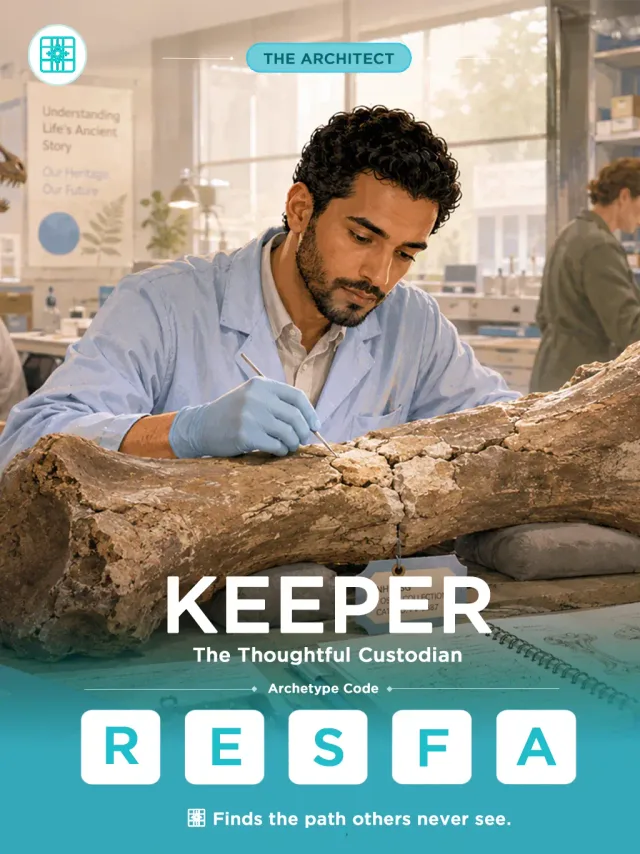
Yours is called The Needle.
The short version
Most people meet a hard thing by pushing at it. Your skin reads the structure of it at a resolution others do not get. Your body changes its angle to match what the reading says. Your mind turns that into a map with a route you can trace. Your social wiring gives one passage everything it has. Then your energy commits, all at once, at the moment the map says to move.
You see, but you do not observe. Arthur Conan Doyle, A Scandal in Bohemia, 1891
Why DNA?
Think of DNA as a recipe book written for you before you were even born. Each recipe describes how to build a different part of you: a type of muscle fibre, a kind of brain cell connection, a layer of skin. You may not have chosen these recipes, but that does not lessen their influence on you.
Therefore, some things about how you work cannot be attributed simply to your habits or personality. You can think of them as your body's factory settings. Knowing your factory settings lets you stop working against your own grain, and start designing a life that fits yourself.
These are your factory settings. You did not choose them, but once you know them you can design around them.
The five settings that make you The Needle are: Adaptive Body, Power Energy, Sensitive Skin, Focused Social Wiring, and Analytical Mind. Let us take a look at each setting.
02 Your Genetic Build
Your five settings
Five settings make you The Needle. Each one is a choice your genes already made, and each one shows up in how you live.
Physical A
Adaptive
Your body is built to adjust rather than to withstand. The genes shaping your connective tissue and your sense of your own position favour recalibration over rigid form. A fixed frame meets an obstacle head on. Yours keeps changing the angle of approach until it finds the gap. Your physical intelligence lives in the adjustment.
Day to day this shows up as competence across many physical situations rather than a peak in one. New ground, an unfamiliar movement, an obstacle that was not there yesterday: your first move is to read what the situation is asking for and re-set, not to apply more force to the last thing that worked.
Your Adaptive body and your Sensitive skin are one instrument, not two. Your skin holds a running reading of the texture around you. Your body adjusts to that reading while it is still moving, in real time, without waiting to be told. Together they are how you find a route through something you have never entered before.
Energy P
Power
Your metabolic genes favour short, concentrated output over long, even output. Your fast-twitch fibres fire quickly and hard, and your phosphocreatine pathway is your first fuel route. The system is built to load, release, and then reload before it can do that again.
In practice, one hour of full commitment will beat three hours of moderate effort for you. Your system climbs to its peak, spends it, and then needs the reload. Holding a middle setting all day gives you neither the peak nor the recovery, so the day ends with a lot of hours used and nothing sharp in them.
Power energy paired with Sensitive skin makes a timing system. Your skin reads continuously for the moment a structure gives. Your energy is held back until that moment arrives, and then all of it goes at once. The precision comes as much from the holding back as from the force.
Skin S
Sensitive
Your skin barrier genes build a thinner, more permeable, more responsive outer layer. It registers environmental signals at a lower threshold than most people's, and those signals reach your nervous system early. This is your busiest input channel, and it does not switch off.
That hands you information other people either never receive or receive much later. You pick up the texture of a room, a surface, a fabric before there is anything obvious to point at. The cost is that the channel has no volume control of its own. Managing what you feed into it is part of keeping the readings clean.
This is the instrument the whole build is arranged around. Something that cannot feel the weave cannot find the gap in it. Your skin does more than report that an environment is busy. It resolves the fine grain of what is in front of you, at a level of detail the rest of your wiring can actually plot a route from.
Social F
Focused
Your brain's social reward system is calibrated for depth. The genes shaping your dopamine signalling pay out when you invest heavily in a small number of commitments. Breadth pays out very little, which is why wide social coverage never pulls at you the way it pulls at other builds.
So a few people and a few problems get all of you, and the rest get very little. The switch between those two states is sharp rather than gradual. Your attention is not spread evenly across a field. It is aimed at one point in it.
For your combination this setting is load-bearing. A route can only be found by going into one passage far enough to see where it opens out. Attention held across many passages at once never gets deep enough into any of them to see anything worth acting on.
Mind A
Analytical
Your brain's prefrontal networks favour sequential, structured processing. You build understanding in layers and check each one before laying the next. You want the logic in language before you commit any movement, which is why you rarely act on a reading you cannot yet explain to yourself.
Threading a hard problem needs the problem mapped first, and your processing does not hurry that step. It assembles a structural model, works out which route has the best odds, and only then sends the output through it. The order matters. Reverse it and the accuracy goes.
Two builds can take identical readings off the same environment and do completely different things with them. Yours turns them into a structure with named parts and a stated route. That has a practical consequence: your answer can be traced backwards. Someone else can walk the map you drew, argue with one step of it, and still use the rest. An answer you can hand over is worth far more than an answer that is only correct.
03 Natural Strengths
What you do well
Your five settings all pull the same way. You can find the line through something complicated, and you can put one move exactly where the line said to put it.
Threading live structure
Your Sensitive skin and your Adaptive body work as one navigation system that runs while you are moving. The skin reads the grain of whatever you are inside. The body changes its angle from that reading, and it does this continuously rather than at planned checkpoints. You read the structure as you enter it, and you find the opening on the way in.
It looks different in each setting and it is the same mechanism every time. On unfamiliar ground you find the one part that will take your weight and use that, without disturbing everything around it. In a technical problem you sense which part of the structure will give, and you point your attention there first instead of working through the whole thing in order.
You do not need the whole map before you go in. You need enough of it to take the next step accurately.
One move, exactly placed
Your Power energy and your Analytical mind make an unusual pair. The energy system has one setting worth using, which is full commitment, and it will not produce a steady moderate stream. The mind refuses to commit until it has the structure mapped. Put those together and you get a single move, released late, landing exactly where the map said it would.
In a negotiation that is one observation that changes what the whole conversation is about. In a technical discipline it is one movement executed at the moment it will do the most. Neither is a burst of effort. Both are a burst of effort that was aimed first.
It is with a pattern as with a fortress, it is no stronger than its weakest point. William Morris, Hopes and Fears for Art, 1882
The head start you already have
Your Sensitive skin picks up environmental signals at a lower threshold than the people around you. You register the texture of a situation while it is still forming, before it has produced anything visible enough to point at and name.
So you tend to notice that a room has warmed or dried out well before anyone mentions it. You feel a texture change under your fingers before it is visible at all. You notice a small change in a physical space that nobody else has consciously clocked. The value is in the gap between your reading and everyone else's, because that gap is time, and time is what lets you map something properly before it becomes urgent.
You knew an hour before the room did. That hour is the asset, not the knowing.
All the way down one passage
Your Focused social wiring and your Analytical mind both reward going far into one bounded thing. The reward signal strengthens with depth of investment. The analytical processing produces its most accurate models once it has had time to work through several layers of the same problem rather than the first layer of several.
Inside a defined problem with real edges, this makes you very hard to match. It also means the work does not need an audience to happen. Whether anyone is watching makes no difference to the quality of the route you find, because the reward is coming from the depth of the engagement itself.
04 Friction Points
Where it costs you
Nothing here is a fault in the build. It is a precision instrument being asked to work in conditions it was never calibrated for.
When the input outruns the map
Your Sensitive skin takes in environmental input at a low threshold. In a managed room that is your main advantage. In a loud, bright, crowded, interrupted one, the volume of incoming signal arrives faster than your Analytical mind can build structure out of it. Your skin will usually report this first, with more reactivity or dryness than its normal baseline.
Read that as a gauge, not a weakness. It is telling you the input has gone past the level your mapping can keep up with. Cut the input, move somewhere quieter, or put a buffer between the noisy thing and the precise thing. Pushing on through costs you the navigational accuracy that is the most valuable output you have.
Past a certain input level you are not reading structure any more. You are just receiving noise.
The reading looks like nothing happening
Your Analytical mind and your Adaptive body both want a reading phase before the accurate output. Take that phase away and ask for high-quality work immediately, and you will produce something noticeably less precise than your normal standard. The requirement is real, and it is not a matter of confidence or willingness.
The friction is that a reading phase is invisible. From the outside it looks like nothing is being done. Say what it is out loud, early, in plain words: you are reading the problem, here is when you will have a route. That one sentence turns a suspicious silence into a stage of the work, and it costs you almost nothing to say.
First comes the choice of a very healthy site. Vitruvius, The Ten Books on Architecture, Book I (trans. Morris Hicky Morgan)
Five passages, none of them threaded
Your Focused social wiring and your Power energy are both calibrated for depth and for one committed release. Neither one divides well. When you carry several demanding things at once, the quality of your mapping drops and the resolution of your skin's reading drops with it, so you lose both halves of the instrument at the same time.
Threading five passages at once gives you five half-routes, not five results. Each one gets the fraction of attention that a whole route needed. The design answer is sequence rather than spread: finish one passage, then start the next. That will feel slower and it will produce more.
Two things at full depth is not the same as four things at half. Half depth finds nothing.
What the instrument costs to run
Reading environmental structure in real time is not free. Your skin is processing input as a baseline state, all day, whether you are using the readings or not. In a high-input environment that draws down the same reserve your precision work needs. Accuracy softens first, then the mapping gets looser, then the early-signal advantage flattens out and you are working blind at the exact point you most need the instrument.
The management strategy is control of the environment before the fact, rather than recovery after it. Your signals arrive early, which is the whole point of them, so you have warning long before you reach the threshold. A small rise in skin reactivity is your instrument reporting on the load. Treat that as the moment to act, not as something to note and carry on through.
05 Body Optimisation
Training your body
Your body is a sensing and adjusting machine with one very good gear. Each of these five settings wants something specific, and the accuracy goes before anything else does.
Train the adjustment (Physical)
Your Adaptive wiring responds to variety and to problems, not to repetition. Your connective tissue and your position sense are built to keep reading and correcting, so the training that suits you is training that asks your body to find its own best position rather than repeat a shape it has already memorised.
Movement that fits this build:
Martial arts, gymnastics, or dance
Bouldering and technical climbing
Balance and footwork drills, where your body corrects its own position
Multi-directional agility work rather than straight lines
A second sport, deliberately unlike the first one
Give the session a proper start. Going from stillness straight into the most technical thing on the list degrades your accuracy, because your body has not yet read the conditions or found its range for that day. Ten minutes of easy, varied movement first is not a warm-up in the usual sense. It is the same reading phase your mind takes, run in your body.
Give your body a few minutes to find the ground before you ask it for anything accurate.
Load it before you spend it (Energy)
Your Power system runs on a fuel route built for short, intense work. Your best windows are 45 to 90 minutes long, and after one you need real recovery before the next. Two short, hard sessions with a clear gap will always beat one long moderate one for you.
Build the rest intervals into the session itself rather than trying to hold a steady effort across it. Your system cannot hold a plateau, so the second half of a long unbroken session is simply worse work than the first half. If you have not recovered since the last burst, the next burst is a lower-quality copy of it.
Protein is your main nutritional variable. Your muscular system and your phosphocreatine pathway both need adequate protein to perform and to repair. Eat a protein-rich meal 60 to 90 minutes before anything demanding, and do not train hungry: for your combination, working hungry reliably costs you accuracy rather than only endurance. Creatine monohydrate is among the best-supported supplements available for Power-dominant types.
Act on the first reading (Skin)
Your Sensitive skin barrier reports early. Reactivity, dryness, or sudden irritation are readouts that environmental load is climbing toward the level where it starts costing you precision, and they arrive well before that point is reached.
That is why a consistent daily skincare routine earns its place here as a monitoring practice rather than a cosmetic one. A steady baseline is what makes a small deviation legible. If you have no idea what your normal looks like, an early signal is just weather. If you do, it is data you can act on days before it would have cost you anything.
Control of your environment counts as training for this build. Sensory load in the room where you do your most careful work is a performance variable in the same way sleep and protein are. A calmer room produces cleaner signals, cleaner signals produce more accurate mapping, and more accurate mapping is the entire output.
Rebuild between the bursts (Recovery)
Three of your settings deplete in different ways and none of them waits politely. Your Power energy empties in concentrated spikes rather than gradually. Your Adaptive body needs its own time to recalibrate between technical sessions. Your Sensitive skin gives you accurate early warning of all of it, which only helps if you use it.
The usual failure for your combination is a delay, not a blindness. The early signal arrives, gets noted, and gets overridden because the load has not yet turned into a visible problem. By the time it is visible, several things have already degraded. Put recovery in the diary before the signal asks for it: one full rest day, protected sleep, and a short weekly look at how the readings have been trending.
Book the rest day. Your skin will tell you early, and you will override it.
Sleep is the highest-value recovery you have. Even a moderate deficit, repeated, will quietly take the edge off your navigational precision, which is the one capability you cannot work around. Protect its length and its quality at least as hard as you protect your best working hours.
06 Mind & Cognition
How you think
Your thinking runs in two stages that always go in the same order. Something reads the ground. Then something builds the map. The answer comes out at the end of that, never at the start.
We are by nature observers, and thereby learners. Ralph Waldo Emerson, Essays: First Series, 1841
Read first, structure second
Stage one is your Sensitive skin gathering raw environmental data. Stage two is your Analytical mind turning that data into a structure with parts and relationships and a route through it. Output arrives after stage two. There is no version of this where you skip stage one and still get your usual quality.
Which means your thinking is only as good as the conditions it was gathered in. Noisy input produces degraded data, and a structure built on degraded data looks just as confident as a structure built on clean data. That is the part worth watching. Sort out the room and you have already improved the reasoning that happens in it.
Fix the room first. Your thinking is only as clean as the signal it was built from.
One problem, all the way in
Your Focused wiring and your Analytical processing both deepen with sustained engagement on one bounded problem. The reward signal grows with investment. The mapping gets more accurate as it moves through layer after layer of the same structure.
So context switching costs you more than it costs most people. Each switch makes your analytical process rebuild the structural model of whatever it left, from the beginning. Do that three times in a session and you never get past the shallow layers, which is exactly where your accuracy advantage does not exist yet. Sequence your work by depth, one thing at a time, and finish before you move.
Every interruption makes you build the map again from the first line.
The map starts before the problem does
Your skin registers structural signals before they are visible to you consciously, and well before anyone else has anything to go on. Your Analytical mind can start assembling from that early data, which means the map is already partly drawn by the time the problem announces itself properly.
This is worth the most in complicated situations where an early accurate reading decides the outcome. In a technical diagnosis you may have the structural fault located before the full set of symptoms is even available. Learning to trust that early signal, and to start working from it rather than waiting for confirmation, is the highest-return cognitive habit for your combination.
Show the route, not just the exit
Your mind builds precise models and your skin feeds it accurate early data, and both of those run faster than you can narrate them. The gap that opens is in the telling. The sensing and the threading finish long before the words for them do.
So people experience your precision as intuition, because the answer is correct and it arrives with confidence and no visible working. That is a misreading with a cost: an answer nobody can trace is an answer nobody can build on, check, or repeat. Slow the telling down on purpose. Practices that help:
Say what you read first, before you say what you concluded
Name the parts of the structure out loud, in the order you found them
Show the routes you rejected and why they closed
Write the map down while it is fresh, not after the fact
A route somebody else can walk is worth more to them than a destination they have to take on trust.
07 Relationship Wiring
How you connect
Your reward system pays out for depth and pays almost nothing for reach. What you give a small number of people is unusually accurate, and it is expensive to produce.
My Friend is that one whom I can associate with my choicest thought. Henry David Thoreau, A Week on the Concord and Merrimack Rivers, 1849
A few, threaded all the way
Your Focused social wiring is calibrated for deep, selective investment. The dopamine reward does not strengthen with a wide network kept ticking over. It strengthens with depth in a small number of commitments, and a wide network simply does not register as reward for your system at all.
So a long conversation matters more to you than an evening of pleasant short ones, and one relationship built over years outweighs a dozen kept alive by regular contact. You do not collect people. You go into one relationship at a time and work it all the way through, which is why the few are so few and so durable.
Care that lands on the actual thing
With the people inside your circle you read what is actually happening, not what would usually be happening, and you respond to that. It is care as navigation: finding the one thing to say or do that meets the real shape of the situation instead of its surface.
People who have been on the receiving end of it describe it as unnervingly accurate. You do not work from generalisations about what people need. You read the current structure of one person's actual experience and answer that. It does have a condition attached: this only works when your skin is not already saturated. Your best relational reading happens in quiet places, which is worth knowing when you choose where to meet someone who matters.
Your attention is expensive to give and unmistakable to receive. Say out loud which one someone is getting.
The hard edge of the threshold
Your Focused wiring has a real edge between full engagement and its absence, and the crossing is abrupt rather than gradual. Either someone has your attention or they do not. This is how your social reward system is built, and it is not something you are choosing in the moment.
To anyone who does not know that, it looks like inconsistency, and the absence gets read as a verdict on them. Explaining the threshold plainly fixes most of that. It also makes the other side visible: the people inside it are receiving something rare, and they will only know that if you tell them, because from where they stand it just looks like how you are.
Rest that asks something of you
Your Adaptive body and your Power energy restore through use, not through stillness. What they want is a physical discipline that runs the whole sensing-and-threading system in a low-stakes setting, where the adjustment is continuous and there is a clear right answer at the end of it. Passive rest does not do this for your combination, and neither does a busy room.
Activities that hit both requirements:
Martial arts
Climbing, indoors or on rock
Archery
Baking, where a small adjustment shows up in the result
An instrument you are still getting better at
The common thread is that your hands keep adjusting and the outcome tells you immediately whether the adjustment was right. That combination recharges your system without the sensory cost that makes most other forms of downtime expensive for you.
08 Career Performance
Where you work best
Some work is built around the exact question your biology keeps asking. Other work will quietly take your best capability away from you, no matter how hard you try in it.
Where you excel
You do your best work where getting through a complicated structure is the actual task. Not more output, not faster output: the path through a difficult problem that other people cannot see a way into. When that is what the role is for, your whole build is pointed at it.
You also do well anywhere accuracy is measured rather than volume. You will rarely be the highest-throughput person in a team, and your output will usually be the most structurally correct: one well-placed intervention that clears a cluster of downstream problems, or a diagnosis that names the exact fault in a complicated system. Places that can only count units of work will misprice you.
The supply of time, though gloriously regular, is cruelly restricted. Arnold Bennett, How to Live on 24 Hours a Day, 1908
What depletes your biological edge
High-sensory, high-interruption workplaces charge you twice. The sensory load degrades the accuracy of your skin's reading, and the interruptions stop your Analytical mind ever finishing a structural model. Both halves of your navigation system are being taken apart at once, which is why open, noisy, meeting-heavy environments cost you more than they cost most of your colleagues.
Roles built on many parallel fronts at high quality are a poor fit for the same reason. Split your attention and your energy across several simultaneous high-stakes demands and every one of them comes out worse than one of them would have alone.
Then there is the measurement problem. Your best work contains a reading phase that produces nothing an observer can see, followed by output that is disproportionately accurate. Somewhere that only counts visible continuous effort will consistently misread what you contribute and ask you to do more of the part that does not matter.
Your slowest-looking hour is the one that makes the fast one accurate.
Leadership signature
As a lead, your Analytical mind and your habit of checking the actual conditions produce a style built on reading the situation accurately before acting on it. You tend to know where the real problem is before anyone has managed to articulate it, and your interventions are few, well timed, and precise. You will not produce a high volume of leadership output. Yours will be the moves that actually change the shape of the situation.
The development edge is turning your navigation into a method other people can watch. When the threading is visible, you are no longer the only one who can read the structure, and you have multiplied yourself into rooms you will never be in. That is worth far more than any number of routes you find on your own.
Best-fit roles
Work that asks where the path through is, and rewards finding it, such as:
Precision medicine and surgical practice
Technical engineering
Software architecture and systems design
Structural and clinical diagnosis
Intervention planning and assessment
Competitive intelligence and investigative research
Precision craftsmanship
09 Live By Design
A life that fits
You do not need a plan for every hour. You need a week that lets the instrument stay accurate and gives it one thing at a time to point at.
Give it new problems (Physical)
Your Adaptive body compounds when it is given things it has not solved before. Train across several movement types rather than perfecting one, and keep a second discipline running that is deliberately unlike the first. Narrow specialisation leaves most of what your body is built for unused.
Give every technical session a reading phase at the start. Your body has to take in the actual conditions of that day and adjust to them before the precise work can begin, and skipping that step is the most common way a good session turns into a sloppy one.
Fill the tank before the window (Energy)
Your Power system loads and releases in concentrated windows, so break the demanding work into blocks of 60 to 90 minutes with real recovery between them. Do not put your most precise work at the end of a long day, after your system has already cycled several times.
Eat ahead of the window rather than after it. A protein-rich meal 60 to 90 minutes before the hard block is the single best preparation available to you, and steady protein across the day is what makes the next burst as good as the last one.
Keep your baseline readable (Skin)
Your skin is the most sophisticated instrument you own and it needs looking after to stay accurate. Manage the sensory load in the places you work most, and act on the early readings instead of overriding them. They arrive early for a reason, and that reason is so that the precision never has to degrade at all.
A consistent daily routine is what makes the early readings legible. Knowing what your normal looks like turns a small deviation into information. Without it, every reading is noise and the whole early-warning advantage is wasted.
Aim it, do not spread it (Social)
Your Focused wiring produces its best from depth with a small number of commitments. Resist the pull to keep wide coverage going out of obligation, because breadth will never pay you back what depth does and the maintenance comes out of the same budget your best work needs.
Name the threshold when it matters, at work and at home. Your full engagement is a rare thing to be handed, and the people inside it should know that is what they are getting rather than having to guess from your behaviour.
Say how you got there (Mind)
Protect the mapping phase on anything that matters. Your Analytical mind only produces its most accurate output after the structure is built, so two or three protected blocks a week will beat double that number of fragmented ones. The fragments never reach the depth where your accuracy starts.
Then hand the map over. Explain the structure you built, show why one route was the one, and say which others you closed off. A conclusion nobody can trace gets taken on trust or ignored, and neither of those is what you wanted when you found it.
A well-designed week
Physical
Three or four skill sessions: a climbing session, a martial arts or dance class, a footwork and balance drill. Ten easy varied minutes at the start of each. Leave 48 hours between the two hardest ones.
Mental
Two or three blocks of 90 minutes, one problem each, phone in another room and nothing booked either side. Spend the first twenty minutes reading the problem before trying to solve it.
Social
One or two long conversations with people already inside your threshold, somewhere quiet: a walk, a kitchen table, an early breakfast. Keep group events off the days you have a hard session.
Recovery
One full day with nothing in it. A fixed bedtime. Five minutes on a Sunday to note how your skin has been this week and how sharp the first ten minutes of each work block felt.
Creative
One hour on something tactile with a right answer: pour-over coffee, a bread dough, an instrument, a fine-detail repair. Your hands adjust, and the result tells you straight away whether the adjustment was correct.
The great thing, then, in all education, is to make our nervous system our ally instead of our enemy. William James, The Principles of Psychology, 1890
The long game
Your skin gets more useful with mileage. The more structures you have been through, the larger its reference library, and the more of an early signal you can actually interpret. You start telling the difference between a reading worth acting on and one that is just weather. That discrimination cannot be rushed. It is built one environment at a time.
Your Adaptive body accumulates the same way, across breadth rather than repetition. Every new discipline adds another set of sensing and correcting patterns to draw from, so your physical intelligence grows with the range of different structures your body has had to learn to read, not with the number of times it has repeated the one it already knows.
And your Analytical mind builds an archive. Every dense problem you have mapped and threaded successfully is a reference for the next one, which makes the next map faster and more accurate to draw. You get better at hard things by having been through more of them, rather than by becoming harder yourself.
That is the part worth knowing early: this build does not blunt with age. It sharpens.
Every structure you have passed through has refined how you read the next one, and every gap you have found has sharpened the instrument that found it. You were built for the exact route through difficult things, and unlike raw force, that only compounds.